
Laura Miller writes for Salon, among other places, about television and books and such. She came to my attention as an early supporter of
Buffy and it's importance to the universe. I've also run across her blurbs on books by Kelly Link. But I've never really had any idea about her. In my mind, I suppose, she has always seemed like a fairly young woman who might wear hip, but not trendy glasses and who might also eat cheerios from the box while reading Charles Dickens and watching Battlestar Galactica. I suppose I have a fairly high opinion of her abilities.
Today, I ran across two Laura Miller things. Thing one was this
excerpt in the Wall Street Journal from her new book,
The Magician's Book: A Skeptic's Adventures in Narnia. It's a memoir/literary critique/treatise on reading and wonder and childhood and what happens when you grow up. It revolves around Ms. Miller's encounters with C.S. Lewis and
Narnia.
The excerpt from the first chapter tells of a Wilanne Belden who loved
The Hobbit as a child, of how thirty years later she placed the first chronicle of
Narnia in the hands of a young and impressionable Laura Miller, and of how much that book, and that series, has meant to her and countless others. She cites Neil Gaiman (who seems to keep popping up in this blog, perhaps because I'm reading Sandman) as saying that, "I would read other books, of course, but in my heart I knew that I read them only because there wasn't an infinite number of Narnia books." In thinking of young Wilanne's passion for Middle Earth, Ms. Miller questions whether "children who prefer books set in the real, ordinary, workaday world ever read as obsessively as those who would much rather be transported into other worlds entirely?"

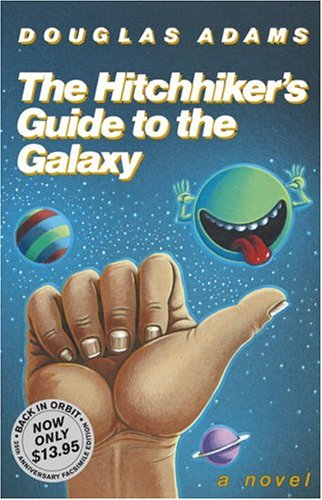
It's wonderful reading and it reminded me of being in my own school library. I'm not sure of my librarian's name, though Mrs. Brown comes to mind, but I remember her directing me to Madeleine L'Engle and Jean Craig-Head George, and eventually and with much glee, to Douglas Adams. And I remember believing in those stories as true. Not true in any sort of metaphorical sense, but true on some deeper level. As though they were, as Gaiman describes Narnia, "reports from a real place."
There is something special about those first worlds we disappear into as children. And maybe there's something unique about those of us who crave stories of worlds entirely different from our own. I don't know. It's quite possible that children who read books about the real world experience a similar visceral thrill, or maybe it's just that those children are given the wrong books. In any case, I hope that some amount of that wonder and surrender which I experienced as a child will remain with me. I hope that every book I read might be the book that changes my life.
I said there were two things, and this was true. In an essay on the New York Times website,
Ms. Miller writes of culling her library--of figuring out, in the great number of books she has collected over the years which are the ones she needs to cling to, and which are the ones she can do without. It's a topic near and dear to my heart. I've experienced very recently someone going through the same process, and I myself, will be going through it once I move from Oxford to points abroad. Books are heavy things and they do not travel easily. Except, of course, for the ones that exist securely and intangibly within your imagination. In which case, perhaps, it's not all that necessary to carry their glue-bound pages with you.
Forgive the contemplative tone, readers. It's Saturday and we all know how Saturdays are. I realize I haven't really ever answered the question of who Laura Miller actually is. Does she, in fact, even like Cheerios? I began this blog post with the idea that I would, here at the end, insert some warm and funny truths which I had discovered about Ms. Miller. But now it seems much more appropriate to leave her, and her eating and watching habits, to the imagination. At least, that is, until one reads
The Magician's Book.
 Good evening, readers. As has been discussed before on this blog, literature isn't always about words. Sometimes it's about pictures. Sometimes, too, it's about girls deflowered by swans, but we'll leave that for some future mythical Monday.
 Speaking of Australian illustrators (by which I mean, of course, illustrators who live in Australia and not the sort of people who spend their time illustrating continents), there's an interview with Shaun Tan over at The Walrus. His 2007 book, The Arrival, won book of the year in Australia. In the same year, he also received the World Fantasy award for best artist. Tales from Outer Suburbia, his latest work due out in the States in February, is a collection of fifteen stories exploring the strange things that sometimes happen in our ordinary world, such as a little girl asking directions from a giant water buffalo.




 Posts
Posts


