For three, A Beautiful Revolution, the blog of Andre Jordan. He wrote a book called Heaven Knows I'm Miserable Now. Maybe don't visit the blog if you're in the mood for cartoons where people do not cut off their heads with a saw. It's kind of funny, though. And it might just make you smile, readers, and so maybe it's exactly the place you've been looking for all your life.
Showing posts with label Comics. Show all posts
Tuesday, April 7, 2009
Robot Tuesday
There's every possibility I'll be unable to post tomorrow, and there were things to important not to mention and arrange pictures about.
For one, Fantagraphics is offering 15% off their roster of Eisner nominated books. These include bits by Kevin Huizenga and John Kerschbaum, collections of Village Voice strips and the WWII cartoons of Bill Mauldin, as well as several editions of The Comics Journal. My favorite, though, based solely on the cover and description would be The Last Musketeer by Jason. "The now centuries-old Athos" panhandles and trades on his old fame until, one day, Martians invade and once again "there is a need for swashes to be buckled..."
For two, I read this past weekend a book called Genesis by Bernard Beckett. If I were to sum it up in a sentence, a perfectly reasonable thing to do, I think, I would say it's a Platonic sci-fi think-piece about what it means to be human in which there are featured: an orangutan robot, occasional laser beams, a shadowy Academy, and one very long and revelatory job interview. Also, it reminded me of a certain movie which I can't mention for fear of ruining certain things. Plus that would involve writing a second sentence about the book.
For three, A Beautiful Revolution, the blog of Andre Jordan. He wrote a book called Heaven Knows I'm Miserable Now. Maybe don't visit the blog if you're in the mood for cartoons where people do not cut off their heads with a saw. It's kind of funny, though. And it might just make you smile, readers, and so maybe it's exactly the place you've been looking for all your life.
Labels:
Andre Jordan,
Comics,
Genesis,
Kevin Huizenga,
Musketeers,
Swashbuckling
Saturday, April 4, 2009
Hello Again
Hello, readers. Events occurred somewhat separate to the Book Conference which involved me reporting less than I had intended. A summary of fun will come, but for now, here are new things which are happening.
David Mitchell, author of Cloud Atlases and Ghostwrittens, as well as a Black Swan Green, will have a new novel out in June 2010. [via Ed]
Gabriel Garcia Marquez retires.
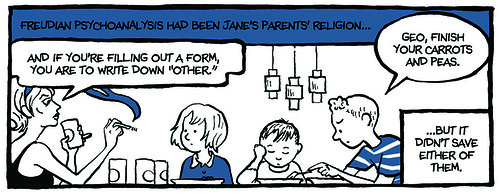
Last week, Alison Bechdel graphically reviewed Jane Vandenburgh's non-graphic, plain text memoir, A Pocket History of Sex in the Twentieth Century. It's beautifully done and made reading the actual book almost seem beside the point, but maybe I just have a thing for predominantly blue comic book panels. In any case, considering the fairly ubiquitous practice of textually reviewing graphic works, it seems high time the tables were turned* on the written word.
In completely unrelated news, here's one more article on the assimilation/acceptance of comic books into the literary establishment. It's actually quite cogent and my somewhat exasperated introduction shouldn't dissuade you from reading it.
The second volume of Interfictions, an anthology of interstitial writing, has a cover and it would be the rising sun swedish congolomeration pictured to your left (unless you're looking at your monitor upside down, in which case, I worry about you). Also, you can go here, and flickr your way through the pool of pictures from which the eventual cover was chosen.
*What if the table's round? Would anyone notice a round table turning? Does it mean to flip someone's table upside down, as in ha-ha, written word, you thought you were going to have a nice spaghetti dinner, but lo, now the table is upside down and your dinner but a flattened memory!
David Mitchell, author of Cloud Atlases and Ghostwrittens, as well as a Black Swan Green, will have a new novel out in June 2010. [via Ed]
Gabriel Garcia Marquez retires.
In completely unrelated news, here's one more article on the assimilation/acceptance of comic books into the literary establishment. It's actually quite cogent and my somewhat exasperated introduction shouldn't dissuade you from reading it.
*What if the table's round? Would anyone notice a round table turning? Does it mean to flip someone's table upside down, as in ha-ha, written word, you thought you were going to have a nice spaghetti dinner, but lo, now the table is upside down and your dinner but a flattened memory!
Labels:
Alison Bechdel,
Comics,
Graphic Novel,
Interfictions,
Interstitial Arts,
New Books
Friday, February 27, 2009
Well, hello. How are you?
I'm fine. Thank you. Except for some things, but then, there are always things and hidden amidst the things are sometimes gnomes or rhinoceroses which liven things up a bit.
And in other news...
March 1-7 is Will Eisner week. He's the creator of The Spirit, among other things. He's a big name in the comics world. So big they named an award after him. So far as I know, he's not related to Michael Eisner, but I've never actually checked.
Yiddish Literature is online and free. If I knew more Yiddish there would be a pun or other funny kvetchy line here.
There's a new Ted Chiang short story, and it too is online and free, in podcast form. Ted's stories are like comets, coming by once every long while or so, sometimes flying backwards, but always wondrous and worth taking a moment to look at. He's also won awards.
Here's an excerpt from The Yalobusha Review's interview with Kevin Brockmeier.
ttfn.
*For the full print interview, though, it will mean shelling over ten bucks. Mail check or money to the address at right and you'll get spiffyness in your mailbox.
And in other news...
March 1-7 is Will Eisner week. He's the creator of The Spirit, among other things. He's a big name in the comics world. So big they named an award after him. So far as I know, he's not related to Michael Eisner, but I've never actually checked.
Yiddish Literature is online and free. If I knew more Yiddish there would be a pun or other funny kvetchy line here.
There's a new Ted Chiang short story, and it too is online and free, in podcast form. Ted's stories are like comets, coming by once every long while or so, sometimes flying backwards, but always wondrous and worth taking a moment to look at. He's also won awards.
Here's an excerpt from The Yalobusha Review's interview with Kevin Brockmeier.
CK: There are some stories like “The Lady with the Pet Tribble” that’s sort of set in a fictional universe, and then something like The Brief History of the Dead, which is the real world, but added on there’s this fantastic element. Are they distinct modes you go into when you’re writing, realistic or fantastic?
KB: I don’t know that they are. Sometimes I’m aware I’m writing a story that won’t permit an element of fantasy, and sometimes I’m aware I’m writing a story that seems to be set in a wholly fictional universe, but oftentimes I’m writing in some weird sort of netherworld between the two, and even with the most realistic stories I write, you know I feel as if in the act of trying to observe the world clearly, it somehow turns into fantasy, anyway. It’s almost unavoidable for me.
CK: Why do you think observing the world clearly leads you toward fantasy?
KB: I’m not quite sure, but I can tell you that the books that I’ve enjoyed reading the most, which is to say the realistic writers I’ve enjoyed reading the most, are often people---oh just, some names like Marilynne Robinson, Louis de Bernieres, William Maxwell, Bohumil Hrabal---who seem to see the world through such a sharp lens that it suddenly becomes strange again in your eyes as you’re reading.
CK: Is that something you strive for when you write, to make the world new again or strange?
KB: New again, definitely; strange, perhaps by accident. It’s often a great effort to make each sentence approach the world with that sort of clarity. So it’s not as if the world is necessarily blossoming open before me in this new way as I’m writing. I'm slowly working to transfigure it in my own eyes.
More excerpts to come (every day next week in fact), including the bits that wouldn't fit within the finite limits of our paper universe. These will be free and online, like so many things these days.*
KB: I don’t know that they are. Sometimes I’m aware I’m writing a story that won’t permit an element of fantasy, and sometimes I’m aware I’m writing a story that seems to be set in a wholly fictional universe, but oftentimes I’m writing in some weird sort of netherworld between the two, and even with the most realistic stories I write, you know I feel as if in the act of trying to observe the world clearly, it somehow turns into fantasy, anyway. It’s almost unavoidable for me.
CK: Why do you think observing the world clearly leads you toward fantasy?
KB: I’m not quite sure, but I can tell you that the books that I’ve enjoyed reading the most, which is to say the realistic writers I’ve enjoyed reading the most, are often people---oh just, some names like Marilynne Robinson, Louis de Bernieres, William Maxwell, Bohumil Hrabal---who seem to see the world through such a sharp lens that it suddenly becomes strange again in your eyes as you’re reading.
CK: Is that something you strive for when you write, to make the world new again or strange?
KB: New again, definitely; strange, perhaps by accident. It’s often a great effort to make each sentence approach the world with that sort of clarity. So it’s not as if the world is necessarily blossoming open before me in this new way as I’m writing. I'm slowly working to transfigure it in my own eyes.
More excerpts to come (every day next week in fact), including the bits that wouldn't fit within the finite limits of our paper universe. These will be free and online, like so many things these days.*
ttfn.
*For the full print interview, though, it will mean shelling over ten bucks. Mail check or money to the address at right and you'll get spiffyness in your mailbox.
Labels:
Comics,
Kevin Brockmeier,
Science Fiction,
Ted Chiang,
Will Eisner,
Yiddish
Thursday, January 22, 2009
Thursday Things
Hello, readers. It's been a while. A few things have happened. There's a new president, for one. People seem to think he'll be great, or possibly fail, but most hope he succeeds. Except for this guy. Also, it's possible that life, the universe, and everything, including you, reader, is just one big hologram.
Three other things, then, from our holographic universe:
Thing 1) Haruki Murakami wins the Jerusalem award, which is given to those authors, like Arthur Miller or Simone de Beauvoir, whose work deals with "human freedom, society, politics, and government."
Thing 2) The Louvre opens an exhibition of original plates by comic book artists, which makes sense considering the French love of Tin Tin and Asterix and other les bandes dessinees. "Just like comics are not only fun or for entertainment," curator Fabrice Douar says, "the Louvre equally is not dusty and boring." [via Rhea Cote Robbins, photo AP/Thimault Camus]
Thing 3) TIME talks the evolution of publishing, relating our current time of economic and technological transformation to the fluxy turn of the 18th century when new fangled things like capitalism and printing technology brought about the "novel" as we know it today. Things like fan-fiction, wikipedia, and YouTube, according to TIME, have lessened the freakiness of self-publishing and pushed copyright to its limits, and may lead to a form of fiction "ravenously referential and intertextual." The article ultimately posits a future dichotomy between Old Publishing ( "stately, quality controled, and relatively expensive" ) versus a New Publishing ("cheap, promiscuous and unconstrained by paper, money, or institutional taste"). [photo Getty/Chris Jackson]
Happy Thursday, readers.
ttfn.
Three other things, then, from our holographic universe:
Happy Thursday, readers.
ttfn.
Thursday, October 30, 2008
Novelists Writing Comic Books

In the latest Onion A.V. comics panel, there's a brief review of the new hard cover collection of Jonathan Lethem's 10-issue revival of Marvel's Omega the Unknown, a 70s comic that focused not so much on the caped Omega, as on an unusually mature twelve year old boy named James-Michael Starling. The Onion gives Lethem's take a B+ and calls it "winningly peculiar." Back in the middle of last year, Newsarama interviewed Lethem about translating his skills as a language loving novelist to the predominantly visual form of comics. One of Lethem's more important realizations? Comic book panels don't hold all that many words.
If you're wondering if other novelists and literary types have swung their way into comic books, the answer is yes they have, and their number is many. Some you might expect, like Michael Chabon, writer of the very pulpy and comic-centric, The Amazing Adventures of Kavalier and Klay, and some you might not, like Ian Rankin, the Scottish crime writer best known for his Inspector Rebus novels. His debut graphic novel, a Hellblazer story, Dark Entries, hits next year. For more examples and discussion, check out these articles from the New York Times, Newsday, and the London Times.
Labels:
Comics,
Ian Rankin,
Jonathan Lethem,
Michael Chabon,
Sherman Alexie,
Videos
Sunday, October 12, 2008
What It Is: Lynda Barry Interview
Happy news, readers! Cartoonist, novelist, playwright, and friend to collages everywhere, Lynda Barry, has agreed to an interview for the forthcoming issue of The Yalobusha Review. She's the creator behind dozens and dozens of comic strips which, in the eighties, gained her a cult following and led to the occasional appearance on "Late Night With David Letterman." Strips of her syndicated comic, Ernie Pook's Comeek, have appeared on Salon and been collected in, The Freddy Stories and The Greatest of Marlys. She's also the author of several sorts of books. The kind with pictures, like Cruddy, named one of the top ten books of the year by EW in 2000, or The Good Times Are Killing Me, winner of the Washington Governor's Writing Award, and the kind with more pictures, the "autobifictionalographic" One Hundred Demons, for example, or the combination memoir/activity book/storytelling manual/all-around paen to images, What It Is. EW called her "America’s leading cartoon artist of childhood angst." From the San Francisco Chronicle: "Barry is not just a storyteller, she’s an evangelist who urges people to pick up a pen—or a brush . . . and look at their own lives with fresh, forgiving eyes.” And Dave Eggers, writing in the New York Times Book Review, said, "Lynda Barry has no peer," and in discussing her work, "we're approaching a word not commonly employed when talking of cartoons, oeuvre." Cartoonist as auteur, indeed.
Check out other reviews and examples of Lynda's work at Salon. Head over to myspace and learn about Lynda's traveling workshop, Writing the Unthinkable. Learn how to draw. Have fun.
Labels:
Comics,
Graphic Novels,
Interview,
Lynda Barry
Friday, September 26, 2008
Cartoonist as Auteur
In honor of The Yalobusha Review opening it's doors, er, pages, to short graphic stories (graphic here meaning pictures, not naked lawyer mud wrestling, although...), here's a couple of links from the world of narrative art.

First, check out those hip geeks at The Wall Street Journal and their article about the life-changing work going on in graphic novels from Europe. Here you'll discover cool phrases like bandes dessinées, and learn that while we yanks have been slow in embracing comic books as a medium for more than the adventures of radioactive men and women, places like France and Belgium have celebrated the many possibilities of the artform for decades: see Tintin or Asterix.

When you're done feeling sophisticated and worldly, head over to Amazon's Omnivoracious and their Graphic Novel Fridays post about the throwback to early sci-fi pulp and wonder that is Fear Agent by writer Rick Remender and artist Tony Moore (Walking Dead). Who doesn't love space suits and tentacle monsters, right?

First, check out those hip geeks at The Wall Street Journal and their article about the life-changing work going on in graphic novels from Europe. Here you'll discover cool phrases like bandes dessinées, and learn that while we yanks have been slow in embracing comic books as a medium for more than the adventures of radioactive men and women, places like France and Belgium have celebrated the many possibilities of the artform for decades: see Tintin or Asterix.

When you're done feeling sophisticated and worldly, head over to Amazon's Omnivoracious and their Graphic Novel Fridays post about the throwback to early sci-fi pulp and wonder that is Fear Agent by writer Rick Remender and artist Tony Moore (Walking Dead). Who doesn't love space suits and tentacle monsters, right?
Labels:
Asterix,
Aya,
Comics,
Fear Agent,
Graphic Novels,
Tintin,
Walking Dead,
Wall Street Journal
Subscribe to:
Posts (Atom)